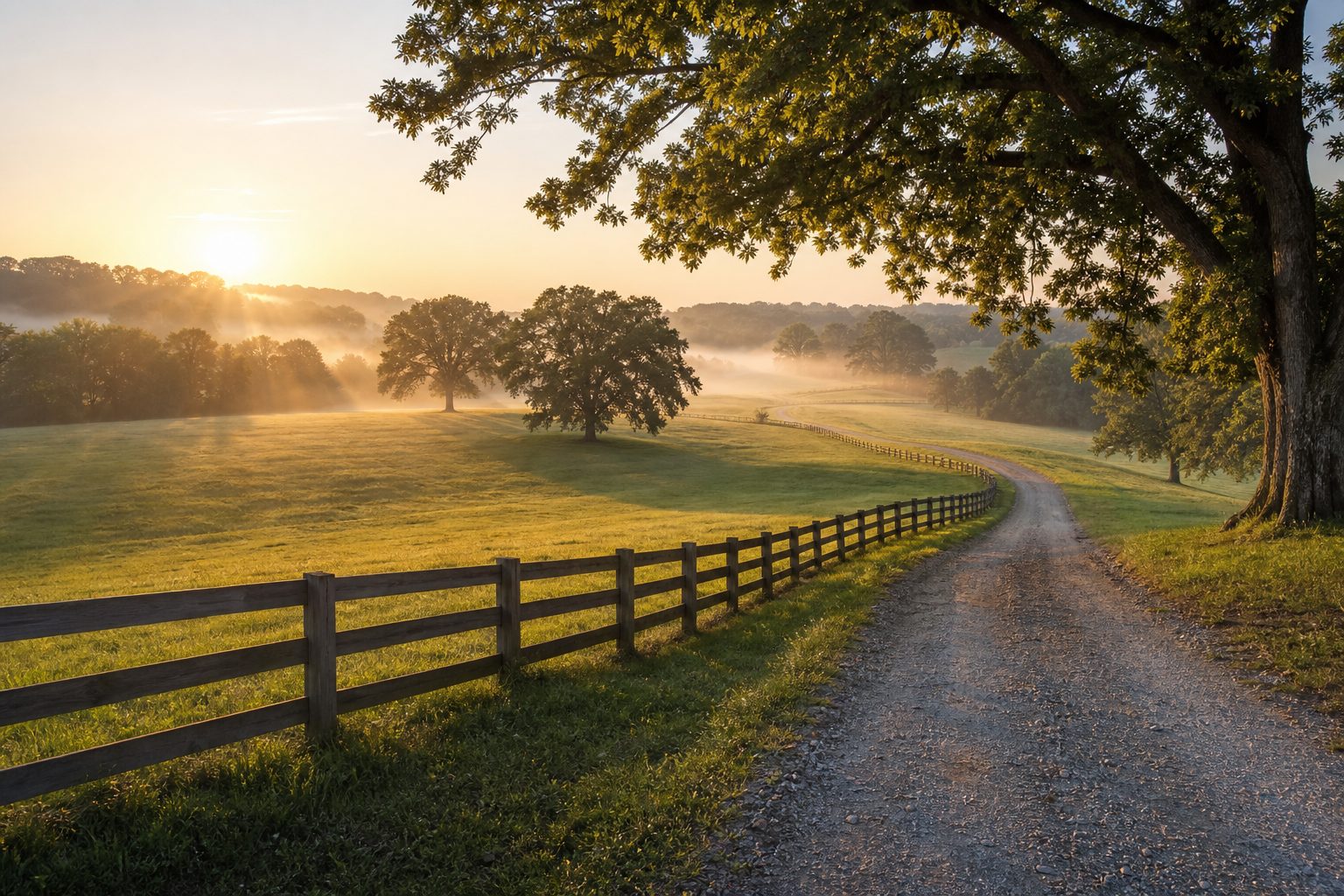
Westmoreland, TN offers rural acreage in northern Sumner County with tracts ranging from 1 to 50+ acres, making it one of the more accessible land markets in the Nashville metro for family compounds, mini-farms, and homesteading. Land seekers should plan for private septic, well water, and utility verification before closing.
Is Westmoreland, TN a good place to buy acreage near Nashville?
Westmoreland, TN is one of the more compelling land markets in the Nashville metro for buyers who want real acreage at a price point that still makes sense. Sitting in northern Sumner County near the Kentucky border, it offers rolling hills, open pasture, and wooded tracts that are increasingly hard to find closer to the city. As of August 2026, a national real estate portal reported roughly 70+ active land listings within Westmoreland's residential boundaries, with tracts commonly ranging from 1 to 20+ acres and a median listing price around $295,000 across all property types.
Why Land Seekers Are Looking at Westmoreland Right Now
Sumner County is growing. According to the Federal Reserve Bank of St. Louis population series for Sumner County, the county's resident population rose from approximately 212,181 in 2024 to 215,538 in 2025. That's steady, sustained growth on Nashville's northern flank, and it's putting land in communities like Westmoreland on more buyers' radar before prices catch up to what's already happened closer to Hendersonville and Gallatin.
The U.S. Census Bureau QuickFacts for Sumner County put the county's estimated population at 211,721 as of July 1, 2024, with 87,113 housing units and an owner-occupied rate of 72.2% for the 2019-2023 period. That ownership culture matters for land buyers. This is a county where people buy to stay, build, and pass property down.
I work with buyers across Middle Tennessee who are looking for land, and the conversation about Westmoreland comes up more than people might expect. The pitch isn't complicated: more land, more privacy, and a price point that still leaves room in the budget to actually build what you want.
What the Acreage Market Looks Like
Public listings on portals like realtor.com's Westmoreland land search and Homes.com show tracts that cluster into a few common ranges. Smaller residential lots run 1 to 5 acres, mid-size rural tracts run 5 to 20 acres, and larger farm or estate parcels push into the 30 to 50+ acre range. Listing remarks frequently call out features like panoramic views, ponds, open pasture, and timber, and phrases like "multiple building sites" or "ideal for a family compound" show up often. That's not just marketing language. It reflects what buyers are actually asking for out here.
For context, Rocket Homes' Westmoreland land listings as of 2025-2026 include parcels in the 13 to 50+ acre range, often emphasizing open pasture and wooded areas with potential for multiple homesites. The August 2026 portal snapshot showed approximately 156 active listings of all types in Westmoreland, with median days on market around 62. These are portal-level indicators, not official MLS data, so treat them as directional rather than definitive. The only way to know what's actually available and priced right is to dig into the current inventory with someone who knows the area.
| Acreage Range | Common Use Cases | Typical Features Noted in Listings |
|---|---|---|
| 1-5 acres | Private homesite, small hobby farm | Cleared lots, road frontage, utility access varies |
| 5-20 acres | Mini-farm, barndominium, family compound start | Pasture and timber mix, ponds, multiple building sites |
| 20-50+ acres | Full family compound, homestead, recreational | Multiple structures, creek frontage, wooded privacy |
Westmoreland vs. Other Rural Options Near Nashville
Buyers I work with who are serious about land typically compare Westmoreland against Portland (also in Sumner County), Bethpage, and parts of Macon and Trousdale Counties. Westmoreland's combination of available acreage, relative affordability compared to closer-in suburbs, and proximity to Nashville's job base tends to move it to the top of that list for buyers who want real rural feel without completely leaving the metro orbit. The Census Bureau's Sumner County housing data shows a median owner-occupied home value of $364,000 for 2019-2023, reflecting the county's overall growth trajectory, but land tracts in Westmoreland's northern corridor have historically offered entry points below that threshold depending on size and infrastructure.
The tradeoff is real. You're farther from Nashville's core than you would be in Hendersonville or Gallatin. For buyers with hybrid or flexible work schedules, that's manageable. For buyers who need to be downtown five days a week, it's a genuine conversation worth having before you fall in love with a piece of land. I'd rather have that conversation early than have a client regret the commute six months in.
What to Know Before You Make an Offer on Westmoreland Acreage
Utilities, Septic, and Rural Infrastructure
This is where land purchases get real. Many rural tracts around Westmoreland rely on private septic systems, and the viability of those systems depends on soil conditions. Perk tests, soil site evaluations, and confirmation of how many bedrooms a site can support are standard parts of due diligence on rural land. Listing remarks for Westmoreland properties frequently call out whether a site has been perk tested or approved for a specific number of bedrooms, which tells you something about how central this issue is locally.
Water access can be public lines, private wells, or a combination, and it varies by road and micro-area. Broadband availability is another question worth asking early, especially if you're planning to work from the property. When a buyer is planning a family compound with multiple structures, all of this gets more complex. You may be looking at separate septic systems, shared well agreements, or infrastructure sizing that needs to be planned before a single shovel goes in the ground. I tell buyers to think about this before they're in contract, not after.
Zoning, Building Sites, and Family Compound Planning
If your vision is multiple homes on one parcel, or adjacent parcels where different family members build separately, the zoning and subdivision questions need to go to Sumner County's planning and zoning office directly. Requirements for multiple dwellings on a single parcel, driveway easements, and shared infrastructure are local and specific. What's allowed on a 20-acre tract in one zone may not be permitted on a similar parcel a few roads over. A surveyor and a conversation with county officials early in the process will save significant time and money. This is the kind of groundwork I help my clients map out before they're deep into a deal.
Disclosure Forms for Vacant Land in Tennessee
Tennessee's Residential Property Condition Disclosure Act, codified under Tenn. Code Ann. §§ 66-5-201 et seq., generally applies to sellers of most 1-4 unit residential properties. For vacant land or unimproved acreage, the picture is different. Raw land may fall into a category where a different form, an exemption, or a statutory disclaimer applies rather than the standard residential disclosure. According to Tennessee's regulatory framework, the Tennessee Real Estate Commission and Tennessee REALTORS® forms include both standard disclosures and land-specific addenda. Ask your agent which forms apply to your specific transaction. Don't assume the residential disclosure covers a raw acreage purchase.
Tennessee's Realty Transfer Tax on Land Purchases
When a deed is recorded in Tennessee, the state imposes a realty transfer tax. According to the Tennessee Department of Revenue's Realty Transfer and Recordation Tax Manual, the statutory rate is $0.37 per $100 of the purchase price or fair market value, whichever is greater. That rate is set by the state and collected by the county Register of Deeds at recording.
What the state does not prescribe is which party pays it. The Tennessee Department of Revenue's recordation tax page sets the rate, but the allocation between buyer and seller is a matter of contract. In Middle Tennessee, this is typically addressed in the purchase agreement and treated as a negotiable item like other closing costs. Review your contract carefully, and confirm the allocation with your title company before closing.
If you're financing the purchase, Tennessee also imposes a separate indebtedness tax on the recording of mortgage or deed-of-trust instruments, at $0.115 per $100 of indebtedness, with the first $2,000 of debt exempt. That's a distinct tax from the transfer tax, and both can apply in a single financed purchase. Your title company will calculate both and show them as separate line items on your settlement statement.
What Your Title Company Does in a Land Purchase
In Tennessee, your title company handles the closing. For a land purchase in Westmoreland, that typically means the title company performs the title search, issues a title commitment, prepares the closing documents, coordinates with your lender if you're financing, collects and disburses funds, calculates and collects the realty transfer tax, and records the deed with the Sumner County Register of Deeds. Closings for Westmoreland transactions often take place at Nashville-area or Gallatin-area title company offices depending on the parties' preferences. Your agent can help you identify a title company experienced with rural land transactions in Sumner County, which matters more than people realize when the deed involves easements, multiple parcels, or non-standard access.
Frequently Asked Questions
Is Westmoreland, TN a good place to buy acreage for a family compound?
Westmoreland is one of the stronger options in the Nashville metro for family compound buyers. The area offers larger rural tracts at accessible price points, rolling terrain with multiple natural building sites, and enough distance from suburban density to create genuine privacy. The practical requirements, including septic viability for multiple structures, zoning approval for multiple dwellings, and driveway and utility planning, need to be worked through before you commit to a specific parcel, but the land inventory supports compound-style development better than most communities this close to Nashville.
How far is Westmoreland from Nashville, and is commuting realistic?
Westmoreland sits in northern Sumner County near the Kentucky border, making it one of the farther rural communities from Nashville's core in the immediate metro area. Commute time varies significantly by destination and traffic, so buyers should drive the route during actual commute hours before deciding. For buyers with hybrid or flexible schedules, the distance is workable. For daily downtown commuters, it's a genuine tradeoff worth evaluating honestly against the lifestyle benefits of the acreage.
What should I look out for when buying 5-20 acres in Westmoreland?
Septic viability is the first thing I walk buyers through on rural land. Confirm whether the parcel has been perk tested and what bedroom count it supports, especially if you plan multiple structures. Beyond that, verify water source (public line vs. well), electricity availability, and broadband access for your specific road and micro-area. Check zoning if you intend to build more than one dwelling, and review any recorded easements or deed restrictions with your title company before closing.
Are there zoning issues if I want to build multiple homes on one parcel in Westmoreland?
Potentially, yes. Whether multiple dwellings are permitted on a single parcel depends on Sumner County's zoning classification for that specific tract, and requirements vary. Some buyers structure family compounds as a single large parcel with multiple structures; others use adjacent but separately deeded parcels. Either approach involves planning and zoning questions that need to go directly to Sumner County officials and a local surveyor before you're in contract. Getting clarity on this early prevents expensive surprises later.
How does Tennessee's realty transfer tax work when buying land, and who pays it?
Tennessee's realty transfer tax is imposed at a statutory rate of $0.37 per $100 of the purchase price or fair market value, whichever is greater, and is collected by the county Register of Deeds at recording, according to the Tennessee Department of Revenue. State law sets the rate but does not assign payment to either party. In Middle Tennessee, who pays is addressed in the purchase contract and is negotiable. Your title company will show it as a line item on the settlement statement and handle remittance at closing.
Ready to Find Your Acreage in Westmoreland?
Westmoreland offers something genuinely rare in the Nashville metro: real acreage, rural character, and room to build the kind of property you actually want, whether that's a private homestead, a mini-farm, or a multigenerational family compound. The key is going in with clear eyes on the infrastructure questions and a plan for zoning before you fall in love with a parcel.
I specialize in land and rural properties across Middle Tennessee, and I know the questions to ask before you're in contract rather than after. If you're serious about finding acreage in Westmoreland or the surrounding area, let's talk through what you're looking for and what's actually available right now. Start with a free home equity report or reach out directly to get a current look at the land inventory that fits your goals.
Equal Housing Opportunity. Julian-Dre Smith is licensed as an Affiliate Broker in Tennessee, regulated by the Tennessee Real Estate Commission (TREC). This article is general information only and is not legal, tax, or financial advice. Confirm your specific numbers and transaction details with your title company, tax advisor, or lender.