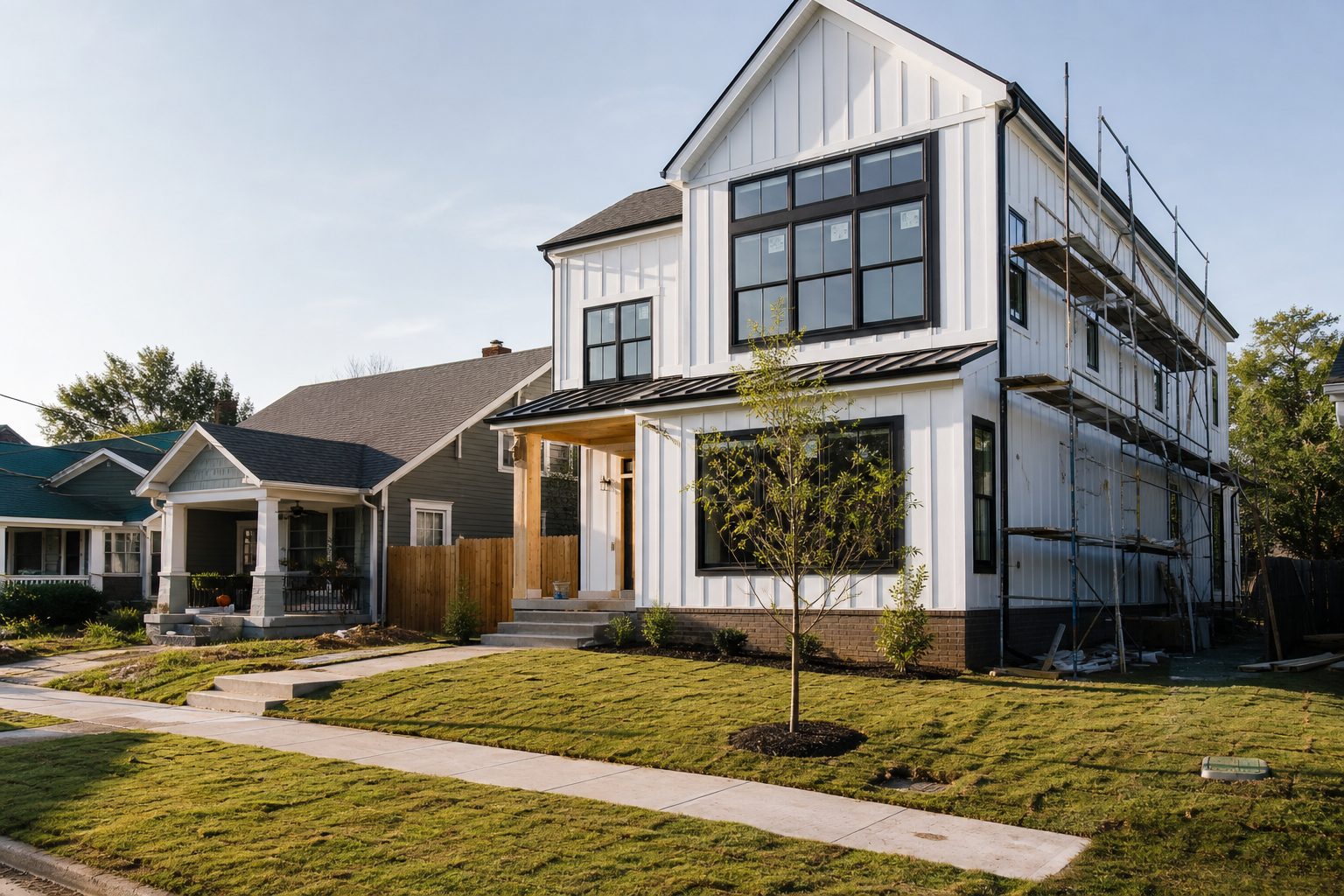
East Nashville's new construction boom is active in 2026, with new builds commanding a significant premium over resales and inventory staying tight. Buyers need to understand builder contracts, independent inspections, zoning changes, and how new construction closings differ from a standard resale purchase.
What do buyers need to know about new construction in East Nashville right now?
East Nashville's new construction boom is real and ongoing in 2026. New builds are commanding a clear price premium over resale homes, active inventory remains tight, and Metro Nashville's permitting activity shows builders are not slowing down. If you're buying in East Nashville, understanding how new construction closings, builder contracts, and zoning changes work will save you from expensive surprises.
East Nashville has always attracted buyers who want to be close to the energy of the city without being in the thick of downtown. What's changed in 2026 is how much of the available inventory is now new construction, and what that means for your budget, your due diligence process, and your long-term expectations.
Here's what I walk every buyer through before they even start touring new builds over there.
The Numbers Behind the Boom
Recent Redfin market data for East Nashville shows that over the three months ending June 2026, the median sale price was $567,000, down about 5.5% from the same period a year earlier. Homes were sitting an average of 54 days on market, up slightly from 50 days in the prior year's window. Those are portal-level figures, not official MLS data, but they give you a useful read on where the broader market is.
Separate recent Zillow market data puts the current East Nashville median sale price at $710,000, with a median of 45 days on market and only 14 active listings available. Nineteen homes sold in the last 90 days. That's a thin inventory picture, and it's one reason new construction is capturing so much buyer attention. When there are almost no resale options, buyers turn to builders.
The gap between those two data points reflects the mix of what's selling. New builds are pulling the overall median up; resales, especially older bungalows and mid-century homes that need work, are settling lower. The practical takeaway: if you're comparing a new build to a resale in East Nashville, you're not comparing apples to apples, and the price difference reflects more than just age.
What the permit data tells us
The building activity behind these sales numbers is backed up by permit data. Metro Nashville's residential permitting has been running at a heavy pace through 2026. Building permits in Nashville are issued by Metro Nashville Codes Administration, and most residential applications go through the Nashville ePermits portal. For standard residential projects with complete, compliant submittals, processing typically runs about 5 to 10 business days. Larger or more complex projects can take longer, especially if plan-review comments require a response.
One zoning change that's quietly reshaping East Nashville's streetscape: Detached Accessory Dwelling Units (DADUs) are now permitted by-right in most residential zones within Nashville's Urban Services District. That means garage apartments, backyard cottages, and similar infill structures can be added to existing lots without the overlay approvals that used to be required. For buyers, that's worth knowing before you purchase: the lot next door or behind you may see additional density added, and the character of a block can shift faster than it used to.
Metro Nashville's permit fee schedule, updated in late December 2025, moved to a flat $5.00 per $1,000 of construction valuation, plus a $25 zoning examination fee and a 10% codes technology fee. Those fees are set by ordinance, not negotiable between buyer and seller, but whether a builder absorbs them or bakes them into the sales price is a business and contract decision. Confirm current fee amounts with Metro Nashville Codes Administration before drawing any conclusions, since fee schedules can change by ordinance.
| Data Point | East Nashville Figure | Source / Period |
|---|---|---|
| Median sale price (3 months ending June 2026) | $567,000 | Redfin, portal-level data |
| Median sale price (trailing ~90 days, Aug 2026) | $710,000 | Zillow market data |
| Median days on market (3 months ending June 2026) | 54 days | Redfin, portal-level data |
| Median days on market (trailing ~90 days, Aug 2026) | 45 days | Zillow market data |
| Active listings (as of Aug 2026) | 14 | Zillow market data |
| Homes sold (last ~90 days) | 19 | Zillow market data |
The spread between those two median figures is meaningful. Individual home values in East Nashville depend on condition, street, build year, and timing. A single area-level median doesn't tell you what a specific address is worth. That's where a local market analysis matters.
What New Construction Actually Means for Buyers
Buying a new build in East Nashville is a fundamentally different transaction than buying a resale. The contract is different, the inspection strategy is different, and the closing process has its own moving parts. Here's what I tell every buyer who comes to me focused on new construction.
Builder contracts are not the same as standard Tennessee contracts
Most new construction sales use the builder's own purchase contract, not the standard forms from the Tennessee Association of Realtors. Builder contracts are written to protect the builder. They often have different timelines for punch-list completion, warranty commencement, and occupancy. Some include clauses that limit your ability to walk away or modify terms. Read every page before you sign, and have a real estate attorney review it if anything is unclear.
Get an independent inspection, even on a brand-new home
New construction buyers sometimes skip the inspection because the home is new. That's a mistake I see cost people real money. Local soil conditions in East Nashville, infill-lot quirks like narrow lots and proximity to alleys, and older adjacent infrastructure can all create drainage, foundation, or utility issues that aren't obvious at a walkthrough. A pre-drywall inspection and a final inspection before closing are both worth doing. The builder's warranty covers certain defects, but it doesn't replace your own due diligence before you close.
According to the National Association of Realtors, inspections consistently rank among the most valuable steps buyers take, and that's especially true in a market where construction is moving fast.
Disclosure rules are different for new construction
Tennessee law generally requires sellers of one-to-four unit residential properties to provide a Residential Property Condition Disclosure Statement, administered under state statute and overseen by the Tennessee Real Estate Commission. But new construction may fall under statutory exemptions, particularly when a builder has never occupied the property and provides alternative warranty documentation instead. That means the paperwork you receive at closing on a new build may look different from what you'd get on a resale. Don't assume you'll receive the standard disclosure form. Ask your agent and the builder's representative exactly what documentation is being provided and what it covers.
The transfer tax and closing logistics
Every East Nashville purchase involves Tennessee's Realty Transfer Recordation Tax, a state-level tax collected by the county Register of Deeds at recording. Under Tenn. Code Ann. § 67-4-409, the rate is $0.37 per $100 of the purchase price, as confirmed by the Tennessee Department of Revenue. State law sets the rate but does not designate whether the buyer or seller pays it. That's negotiated in the contract. Local custom varies, and different closing attorneys and title companies handle it differently. Confirm who is responsible in your specific contract before you assume.
New construction closings also require the title company to coordinate with the builder on final certificates of occupancy, new surveys, and lien releases. In a market with as much active construction as East Nashville, those details can affect your closing date. Your title company and your agent should both be tracking that checklist closely.
HOA rules and short-term rental restrictions
Many East Nashville new builds, especially townhome clusters, come with homeowner associations. Those HOA bylaws can govern parking, exterior changes, and whether you can rent the property short-term. On top of that, Metro Nashville has its own overlay regulations and short-term rental rules that apply regardless of what the HOA says. If you're buying a new build with any intention of renting it, short-term or otherwise, review both the HOA documents and the applicable Metro Nashville regulations before you close.
I also tell buyers to check Metro Nashville's open permit data or ask their title company to flag any active permits on adjacent lots. East Nashville is still actively building, and knowing what's planned for the lot next door can affect your decision. Every situation is different, and the only way to know what you're walking into is to run through those details with someone who knows this market.
Broker fees are negotiable
Whether you're buying a new build or a resale, broker fees and commissions are fully negotiable and not set by law. There is no standard or customary rate. The listing fee is agreed in the seller's or builder's listing agreement, and any compensation a seller or builder chooses to offer a buyer's agent is optional and separately negotiable. If you have questions about how representation works in a new construction transaction, that's a conversation worth having before you walk into a builder's sales office.
Frequently Asked Questions
Is East Nashville's new construction boom driving up prices compared to older homes?
Yes, new builds are commanding a clear premium over resales in East Nashville. The gap between recent data points, with portal-level medians ranging from $567,000 to $710,000 depending on the time window and data source, reflects in part the mix of new construction versus older homes in the sales pool. Resale buyers, especially those targeting historic bungalows or mid-century homes, may find more pricing flexibility, but those properties often come with older systems and potential renovation needs.
Are there still good deals on resale homes in East Nashville, or is everything shifting to new construction?
Resale inventory in East Nashville is thin, with only 14 active listings as of recent Zillow market data, but resale homes do offer different value. Buyers willing to take on older systems or cosmetic updates can often negotiate more flexibility on price and terms than they'd get from a builder. The trade-off is character and location versus modern finishes and warranties. Your situation determines which makes more sense, and that's worth talking through before you commit to either path.
What should I watch out for when buying a newly built home in East Nashville versus a historic bungalow?
With a new build, focus on the builder contract terms, independent inspections (pre-drywall and final), HOA bylaws, and whether the certificate of occupancy and lien releases will be in place at closing. With a historic bungalow, the Residential Property Condition Disclosure Statement and a thorough inspection of older systems, foundation, and roofing are your main tools. Both paths require due diligence, just in different forms. I walk my clients through the specifics before they make an offer on either.
Who pays the Tennessee real estate transfer tax at closing when I buy a home in Nashville?
Tennessee's Realty Transfer Recordation Tax is set at $0.37 per $100 of the purchase price under state law, but state law does not designate who pays it. In practice, it's negotiated between the parties in the purchase contract. Local custom and the specific contract terms determine the allocation, so confirm it in writing before you close rather than assuming it falls to one side or the other.
Do I still get a Residential Property Condition Disclosure Statement if I'm buying a brand-new construction home in Tennessee?
Not necessarily. Tennessee law requires the disclosure statement for most resale transactions involving one-to-four unit residential properties, but new construction may qualify for statutory exemptions, particularly when the builder has never occupied the property and provides alternative warranty documentation. The paperwork you receive on a new build may look different from a resale disclosure. Ask your agent and the builder's representative exactly what documentation is being provided before you close.
East Nashville's new construction market in 2026 rewards buyers who do their homework. The inventory is tight, the prices reflect a real premium for new builds, and the closing process has details that can catch an unprepared buyer off guard. The good news is that none of this is complicated once you know what to look for.
If you're weighing a new build against a resale in East Nashville, or you want to know what the current inventory actually looks like, I'm happy to walk through the numbers with you. Find out what your home is worth or reach out directly to talk through your options.
Equal Housing Opportunity. Julian-Dre Smith is licensed as an Affiliate Broker in Tennessee, regulated by the Tennessee Real Estate Commission (TREC). This article is general information only and is not legal, tax, or financial advice. Confirm your specific numbers and circumstances with your attorney, tax advisor, lender, or closing officer.