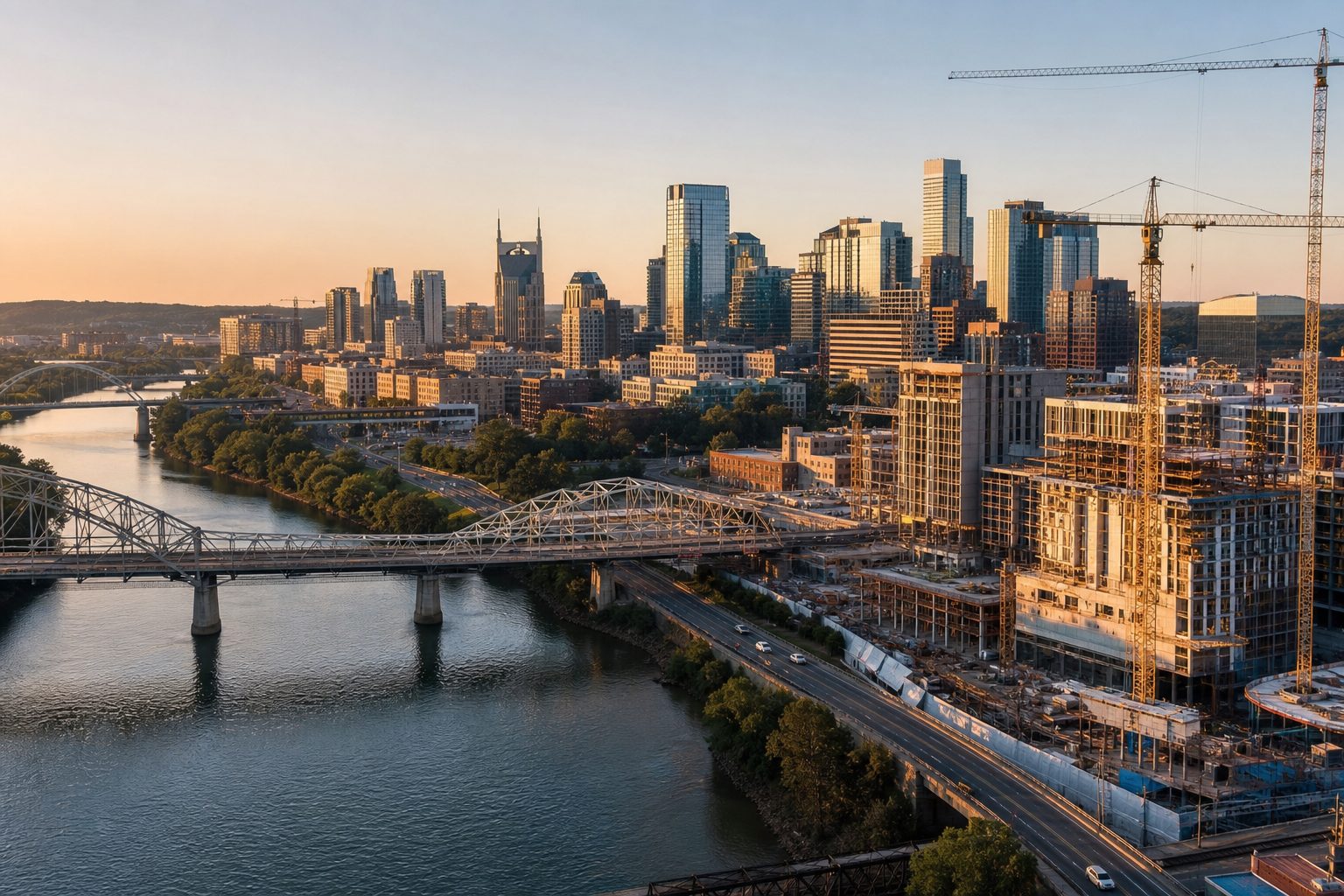
Nashville is investing heavily in transit, waterfront redevelopment, and corridor upgrades that are reshaping long-term property demand. Key projects include the East Bank redevelopment, the Choose How You Move transit initiative, a proposed Music City Loop, and city-wide streetscape improvements across Davidson County.
How are Nashville's infrastructure projects affecting real estate values and growth?
Nashville is advancing several major infrastructure investments, from a $220 million transit fund to a full waterfront redevelopment on the East Bank, that are reshaping how buyers and sellers think about long-term property value. Home price growth has moderated to about 1% year-over-year as of December 2025, but the city's labor force and population continue to expand, and these infrastructure projects are the clearest signal of where demand is headed next.
I work with buyers and sellers across Middle Tennessee every day, and I can tell you: the clients who pay attention to infrastructure are the ones who make the most confident decisions. Here's what I'm watching, and why it matters for your real estate plans right now.
The Projects That Are Actually Moving
Not all infrastructure announcements are equal. Some are aspirational. Some are funded and under construction. Knowing the difference is how you make a smart real estate decision instead of chasing a headline.
East Bank Redevelopment
This is the biggest urban infill story in Nashville right now. The East Bank area, along Interstate Drive, South 2nd Street, and Shelby Avenue, is being transformed with utility infrastructure, mixed-use development, and affordable housing. According to the City of Nashville's East Bank Quarterly Report for Q4 2025, the earliest project expected to break ground in 2026 is East Bank Flats, which will include more than 300 units of affordable housing and a dedicated childcare space.
Water and utility infrastructure within the East Bank is reported as on schedule, with completion anticipated near the end of 2026. Substantial completion of one phase was targeted for September 2026, with other design work moving into construction in summer 2026.
For buyers considering Germantown, East Nashville, or Rutledge Hill, this redevelopment matters. Riverfront connectivity and the density of investment being poured into that corridor create real long-term demand pressure on nearby residential blocks. I'm not making a price prediction, nobody should, but I am watching the East Bank closely for every client I work with in that part of the city.
Choose How You Move: $220 Million in Transit Investment
Nashville's Choose How You Move initiative is funded by a half-cent sales surcharge that launched on February 1, 2025. As of August 14, 2026, the program had committed $220 million toward transportation capital improvements across Davidson County.
The current focus areas include:
- All-Access Corridor improvements on Nolensville Pike and Gallatin Pike/Main Street
- Construction of the Donelson Transit Center, part of a $25.3 million transit center expansion package
- Planning for future transit centers to improve connectivity across the county
- Modernization of traffic signals along major corridors
- Expansion of the WeGo public transit fleet
- Sidewalk construction and Complete Streets improvements throughout Davidson County
If you're buying near Nolensville Pike, through Woodbine, Lenox Village, or toward Antioch, or along Gallatin Pike into East Nashville, Inglewood, or Madison, these corridor upgrades are directly relevant to your commute options and walkability. Better bus reliability and pedestrian infrastructure don't just make daily life easier; they become part of how buyers talk about a neighborhood when it's time to sell.
The Donelson Transit Center is particularly worth watching. Donelson is already a commuter-oriented suburb near the airport and downtown, and a more significant multimodal hub there adds a layer of connectivity that buyers increasingly factor into their decisions.
Music City Loop: The Underground Wildcard
On July 28, 2025, Tennessee Governor Bill Lee announced The Boring Company's intent to build the Music City Loop, an underground private transportation system described as a zero-cost-to-taxpayers mobility project. The announcement projected a first operational segment as early as fall 2026, subject to permitting and approvals.
As of August 28, 2026, this remains a planned private project. I'd treat it as a speculative mobility upgrade, one worth watching, but not one to base a purchase decision on today. If it delivers, the impact on commute patterns and property marketing near connected nodes could be significant. If timelines slip, as large infrastructure projects often do, the fundamentals of the neighborhoods it would serve still hold.
LED Streetlights and Safety Corridors
This one flies under the radar, but it matters more than people think. The Nashville Department of Transportation is executing a city-wide LED streetlight overhaul that is projected to save Nashville $20 million in energy costs and reduce greenhouse gas emissions by 36,000 metric tons over ten years. The NDOT project page was updated in June 2026, making this current information.
Beyond the fiscal and environmental numbers, upgraded lighting improves nighttime visibility, curb appeal, and the general feel of a residential block. NDOT's broader program also includes school zone improvements and intersection safety projects on the High Injury Network, the kind of infrastructure that quietly shapes buyer preferences around school-adjacent and high-traffic areas.
What the Market Backdrop Looks Like
Infrastructure investment doesn't happen in a vacuum. Here's the market context it's unfolding in.
According to PNC's April 2026 Regional Economics Analysis, the most current comprehensive market report available as of August 28, 2026, the seasonally adjusted Case-Shiller Home Price Index for Nashville rose about 1% year-over-year in December 2025. That's the slowest annual increase since 2016. Price growth has cooled, but it hasn't reversed.
At the same time, Nashville's civilian labor force grew 3.0% year-over-year in December 2025, accelerating from 1.5% in December 2024 and outpacing the national labor force increase of 1.8% over the same period. The metro population sits at approximately 2.2 million residents, with in-migration continuing to add to long-term housing demand.
That combination, moderating prices, strong employment growth, and active population expansion, is exactly the backdrop where infrastructure investment tends to matter most. When prices aren't running away from buyers, the neighborhoods positioned for long-term growth become clearer to identify.
| Indicator | Figure | Period |
|---|---|---|
| Nashville metro population (est.) | ~2.2 million | April 2026 (PNC estimate) |
| Labor force growth (YoY) | 3.0% | December 2025 |
| Case-Shiller HPI growth (YoY) | ~1% | December 2025 |
| Choose How You Move commitments | $220 million | August 14, 2026 |
| East Bank Flats affordable units planned | 300+ | 2026 groundbreaking |
| LED streetlight project energy savings (10-yr) | $20 million | NDOT, June 2026 |
Source: PNC Regional Economics Analysis, April 2026; Choose How You Move, August 2026; East Bank Q4 2025 Report; NDOT Projects, June 2026.
Every situation is different, and knowing which projects are most relevant to a specific property or neighborhood requires someone who's actually watching this market day to day. That's the kind of conversation I have with my clients before we ever start touring homes.
Frequently Asked Questions
How will the East Bank redevelopment affect home values in nearby Nashville neighborhoods?
The East Bank redevelopment is bringing utility infrastructure, mixed-use density, and more than 300 affordable housing units to a formerly underused riverfront corridor. Nearby neighborhoods like Germantown, East Nashville, and Rutledge Hill are positioned to benefit from improved connectivity and increased investment activity over time. No one can predict exact price impacts, but large-scale urban infill consistently shifts buyer attention toward adjacent residential areas.
What is the Music City Loop and could it change commute times or property demand in Nashville?
The Music City Loop is a proposed underground private transportation system announced by Governor Bill Lee and The Boring Company in July 2025. The announcement projected a first operational segment as early as fall 2026, subject to permitting. As of August 28, 2026, it remains a planned project, and exact routing has not been fully detailed. It's worth monitoring, but I'd treat it as a speculative mobility upgrade rather than a confirmed factor in a purchase decision today.
Which Nashville infrastructure projects should I watch if I'm buying near Nolensville Pike or Gallatin Pike?
Both corridors are priority areas under Nashville's Choose How You Move initiative, which has committed $220 million toward transit and streetscape improvements as of August 2026. Nolensville Pike and Gallatin Pike/Main Street are designated All-Access Corridors, meaning they're targeted for improved bus reliability, traffic signal modernization, and pedestrian infrastructure. If commute convenience and walkability matter to you, these upgrades are directly relevant to neighborhoods along both corridors.
Does Tennessee have a real estate transfer tax when I buy a home in Nashville, and who usually pays it?
Yes. Tennessee imposes a statewide realty transfer tax under Tenn. Code Ann. § 67-4-409 on documents evidencing transfers of real property when they're recorded. The Tennessee Department of Revenue's guidance designates the grantee (typically the buyer) as the responsible party by default, but contracts between buyer and seller can allocate this cost differently. Confirm how it's handled in your specific contract with your title company.
Is Nashville's housing market still growing, or have home prices started to level off?
Both. The most recent data available, from PNC's April 2026 Regional Economics Analysis, shows Nashville's Case-Shiller Home Price Index rose about 1% year-over-year in December 2025, the slowest pace since 2016. Prices are still moving up, just not at the pace of earlier years. Meanwhile, Nashville's labor force grew 3.0% year-over-year in December 2025, outpacing the national rate of 1.8%, which keeps long-term demand intact even as appreciation moderates.
When will major Nashville infrastructure projects like the Donelson Transit Center and East Bank Flats be completed?
The Donelson Transit Center is part of a $25.3 million transit center expansion funded through Choose How You Move, with construction underway as of 2026. East Bank Flats was anticipated to break ground in 2026, with some East Bank infrastructure phases targeting substantial completion by September 2026 and water/utility work expected near the end of 2026, per the city's Q4 2025 East Bank Quarterly Report. Timelines on large public projects can shift, so I'd check the city's project pages for the most current status.
Nashville's growth story in 2026 isn't just about home prices, it's about the infrastructure being built right now that will shape where buyers want to be five and ten years from now. If you're trying to figure out where opportunity is and how these projects connect to a specific property or neighborhood you're considering, that's exactly what I help my clients work through.
Curious what a property near one of these corridors is actually worth today? Start with a free home equity report and let's talk about what the data means for your situation.
Equal Housing Opportunity. Julian-Dre Smith is licensed as an Affiliate Broker in Tennessee, regulated by the Tennessee Real Estate Commission (TREC). This article is general information only and does not constitute legal, tax, or financial advice. Confirm your specific costs and transaction details with your title company, tax advisor, or lender.